

TL;DR — 9 mistakes, ranked by hidden cost:
- Standup as source of truth → make the task system the source, the meeting a thin layer.
- Visibility ≠ control → one source, many views. Stop building parallel reports.
- “I’ll just Slack you” handoffs → any request > 5 min becomes a task before it leaves chat.
- Mixing async + real-time in one queue → tag work now / this week / this month / this quarter.
- The visibility tax → output should be observable passively (auto “what shipped” digests).
- Dependencies as someone else’s problem → every “blocked” status needs an unblock owner + deadline.
- “In progress” ≠ “active right now” → hard cap WIP at 3 per person.
- Optimizing for the most-organized member → quarterly minimum-viable-system audit.
- Skipping the weekly review → 30-min Friday ritual, three questions.
Every remote team rediscovers the same nine mistakes. The patterns don’t depend on industry, time zone, or team size — they show up in five-person startups and 500-person enterprises with the same predictability. The good news: each one has a concrete fix, most of them tool-agnostic, and a few of them you can apply this week.
Here are the nine mistakes, ranked by how much hidden cost they create.
1. Treating the standup as the source of truth
The mistake. The team uses a daily or weekly video standup as the authoritative status check. People show up, recite what they did yesterday, and leave with a vague sense of what’s happening. By Wednesday, half the room has forgotten what the other half said on Monday.
Why it hurts. Standups are an oral tradition. They don’t survive contact with a calendar. A remote team distributed across three time zones can’t realistically attend the same standup, and the people who skip become second-class citizens. The information dies in the meeting.
The fix. Make the task system the source of truth, and the meeting a thin layer on top of it. Every task should have a current owner, a current status, and a last-updated timestamp that you can scan in under 30 seconds. The standup becomes “anything not visible in the system?” — usually a five-minute conversation, not a thirty-minute one.
2. Confusing visibility with control
The mistake. Managers respond to remote uncertainty by adding more dashboards, more reports, more “quick check-ins.” The team starts spending more time reporting on work than doing it.
Why it hurts. Every status update has a cost — usually invisible, always real. A 15-minute reporting tax per person per day, across a 10-person team, eats 150 minutes daily. That’s two and a half engineering hours a day, every day, gone to producing the appearance of progress.
The fix. Adopt a “one source, many views” rule. The team enters status into one place. Managers, leadership, and stakeholders consume different views of that same data. If a stakeholder needs a different cut, you build a saved filter — not another report. The work is the report.
3. Letting “I’ll just Slack you” replace task assignment
The mistake. Work gets handed off in chat. “Hey, can you take a look at this?” “Sure.” Three days later neither person remembers whether anything happened.
Why it hurts. Chat is an excellent medium for talking about work and a terrible medium for tracking it. Messages scroll. Threads get buried. The handoff has no due date, no priority, no owner of record. When something falls through the cracks, the post-mortem is impossible because there was never a record of who agreed to what.
The fix. Adopt a one-line rule: any request that takes more than five minutes to complete becomes a task before it leaves chat. The Slack message stays — that’s the conversation. The task captures the commitment. Most modern task managers have a “create task from chat” integration; if yours doesn’t, a five-second copy-paste is fine. The friction is worth it.
4. Mixing async work and real-time work in the same queue
The mistake. The team’s task list mixes “respond to customer ticket within 2 hours” with “rewrite the onboarding flow over the next quarter” with “review PR by EOD.” Everything looks the same. Everything feels equally urgent.
Why it hurts. When everything is urgent, nothing is. The 2-hour ticket and the 12-week project compete for the same attention. People default to the smallest, most reactive work because it produces the fastest sense of completion. The strategic work atrophies.
The fix. Use a temporal dimension separate from priority. Tag work as now, this week, this month, this quarter. The “now” lane is reactive and gets handled real-time. The “this quarter” lane is strategic and gets carved into weekly chunks during a Monday planning ritual. Same task list, two different review cadences.
5. The visibility tax (and why introverts pay it twice)
The mistake. In remote work, visibility is performative. People who post often, comment often, and react to messages get noticed. People who quietly close 12 tasks a day get ignored. Promotions and trust drift toward the visible, not the productive.
Why it hurts. This is one of the most insidious patterns in remote teams. It corrodes culture in two directions at once: it rewards the wrong behavior in extroverts, and it punishes the right behavior in introverts. Within 18 months, your most reliable closers are looking for new jobs.
The fix. Make output observable in a passive way. A weekly “what shipped” digest, generated automatically from closed tasks per person, beats any active reporting. The introvert who shipped 47 tickets this week shows up next to the extrovert who posted 47 messages. Both have data; only one is reliably valuable.
6. Treating dependencies as someone else’s problem
The mistake. A task says “blocked by design” or “waiting on legal” and sits there for two weeks. No one owns the unblock. The blocker is treated as an inert state instead of an action item.
Why it hurts. Dependencies are where remote teams quietly bleed velocity. In an office, the blocker resolves itself when you bump into the right person at the coffee machine. Remote, that resolution doesn’t happen by accident — it has to be designed.
The fix. Every “blocked” status needs an owner of the unblock and a deadline for the next attempt. If a task is blocked by design, the unblock owner isn’t the designer — it’s the person who needs the design. Their job is to ping, escalate, and have a backup plan if the original blocker doesn’t resolve. “Waiting” is not a status. “Owen pinging Maya by Thursday with backup plan if no reply” is a status.
7. Confusing “in progress” with “active right now”
The mistake. Half the tasks on the team’s board are marked “in progress.” The board is a graveyard of started-but-not-finished work. Nothing is moving fast because everything is moving slowly at once.
Why it hurts. Work-in-progress is silent debt. Each open task carries a context-switching cost every time you return to it. Five “in progress” tasks across a single person’s queue means that person is paying the context-switch tax five times a week, minimum.
The fix. Hard cap WIP per person at three. Anything beyond three has to be either finished, deliberately paused (with a “resume by” date), or dropped. The team will resist this — it feels like fewer things are happening. In reality, more things are finishing, and finishing is what counts.
8. Optimizing for the most-organized team member
The mistake. The team’s task system has been progressively customized by whoever cares most about it — usually the most-organized person on the team. Custom fields, nested folders, complex tagging schemes, intricate filters. Everyone else is quietly drowning.
Why it hurts. A task system is only useful if everyone uses it. The moment the system requires a 20-minute training to onboard, half the team starts working around it — they keep their own private todo lists, they update the official system once a week (badly), they stop trusting it entirely. The most-organized person is now the only one whose data is real.
The fix. Run a “minimum viable system” audit every quarter. Identify the three fields everyone reliably uses. Make those the only required fields. Demote everything else to optional. If a custom field has < 50% adoption after a quarter, it goes away. The system has to fit the median user, not the maximum user.
9. Skipping the weekly review
The mistake. Tasks accumulate. Some get done, some get stale, some get duplicated, some quietly become irrelevant. Without a recurring sweep, the system fills with noise, and the noise drowns the signal.
Why it hurts. This is the meta-mistake — the one that makes all the others worse over time. A team can survive any of the first eight if they have a weekly cleanup ritual. A team that only does the weekly review and ignores the other eight will still outperform a team that does everything else and skips the review.
The fix. A 30-minute Friday weekly review is non-negotiable for every team member. Three questions: (1) What’s open and stale (no movement in 7+ days)? (2) What’s done but not closed in the system? (3) What’s coming next week and do I have capacity? The answers don’t have to be shared — the act of asking is what matters.
The pattern underneath the patterns
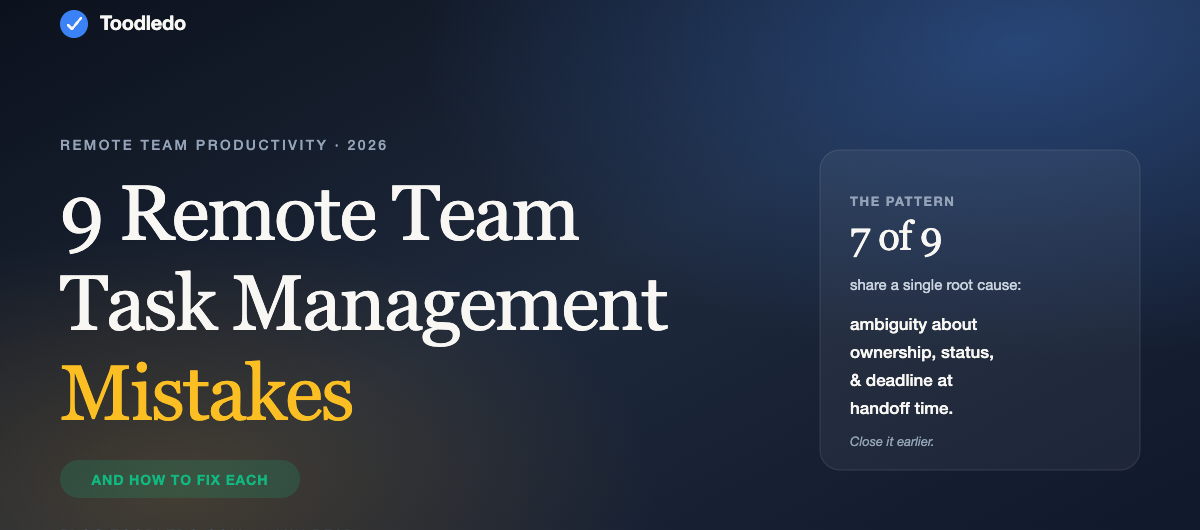
If you read these nine carefully, the same root cause shows up in seven of them: ambiguity about ownership, status, and deadline at the moment work is created or handed off. The fixes all amount to closing that ambiguity earlier in the workflow. Not later in the dashboard.
Remote teams don’t fail because the technology is bad. They fail because the rituals that used to happen by accident — the hallway conversation, the desk drop-by, the shared whiteboard — now have to be designed deliberately. The teams that design those rituals well outperform the teams that wait for them to emerge.
If your team is feeling any of these, pick the one that’s costing you the most this week and fix that one. Don’t try to fix nine things at once. The compound effect of fixing one mistake every two weeks for a quarter is enormous.
Try Toodledo free for 14 days. Built for the kind of teams that close work, not just the kind that report on it. Custom fields, contexts, shared task assignment, and a Friday review view that takes 30 minutes and gives you back hours.
Related reading
- How to Build a Weekly Review Habit That Actually Sticks
- Toodledo vs Todoist (2026): Which Task Manager Fits Your Workflow?
- Toodledo vs Pocket Informant (2026): Features, Pricing & Migration Guide